

Are homes in Alicante expensive? It depends what you measure them in
Are homes in Alicante expensive? In euros, yes: 2,783 €/m² in October 2026, the highest value in idealista's series. But the answer changes with the yardstick and the starting year: adjusted for inflation, homes cost 17.5% less than at the 2006 peak, but 69% more than at the 2013 low.
Key points
- In euros, homes in Alicante province are at a record high: 2,783 €/m² in October 2026 (idealista).
- Adjusted for inflation they cost 17.5% less than at the 2006 peak, but 69% more than at the 2013 low.
- In gold, in years of salary or in another currency the picture changes again: the starting year matters as much as the yardstick.
A different way to look at prices. A home's price is always measured in something, usually euros. But the euro changes in value too. This article does not say whether it is a good time to buy or sell: it looks at the same home with other measuring sticks, to see its price from a different angle.
In euros: a record high
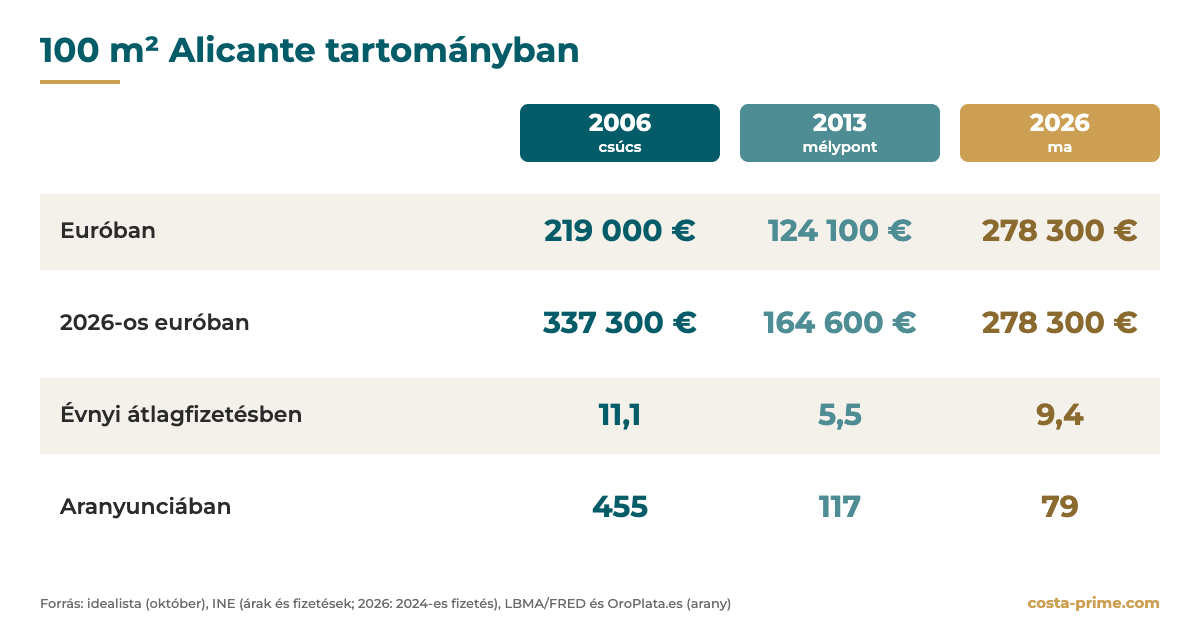
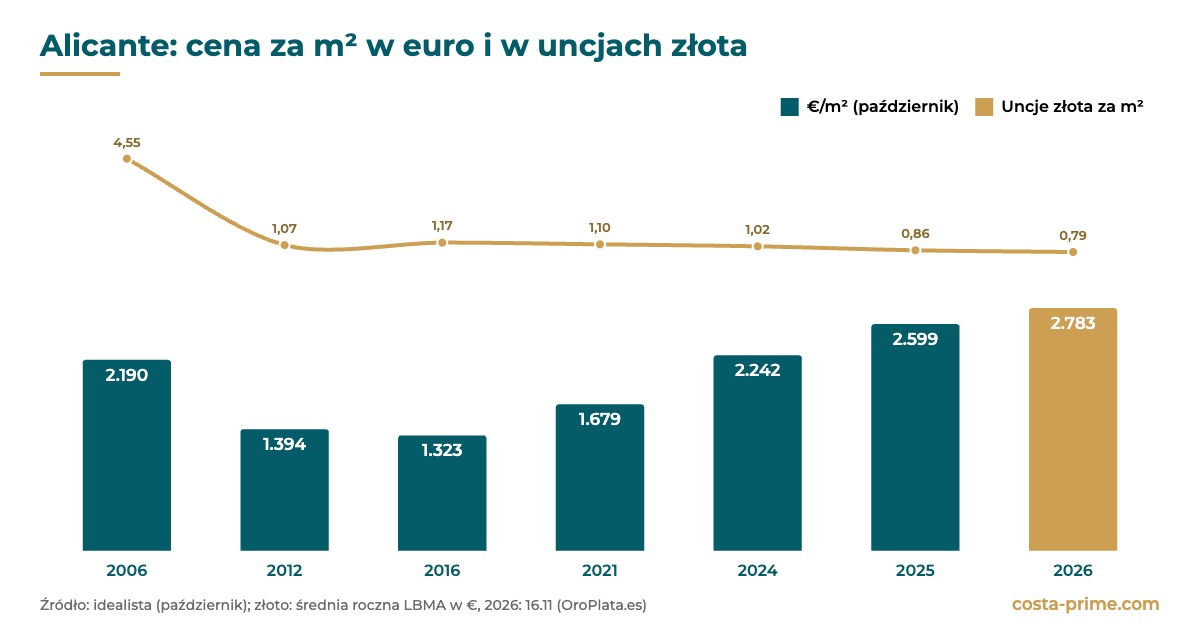
idealista's series for Alicante province shows the full cycle: 2,190 €/m² in October 2006, a low of 1,241 €/m² in October 2013 and 2,783 €/m² in October 2026, the highest in the series. Registered sale prices are rising too, as we saw in Q3 2026 registry data for Alicante. These are asking prices for the whole province.
In today's euros: below 2006
The euro, like the dollar or the pound, is fiat money: its value is not backed by gold or any other asset, but by trust in the central bank that issues it. When prices rise, every euro buys less. According to Spain's CPI (INE), prices rose 54% between October 2006 and October 2026, and 4.9% in the last year alone.
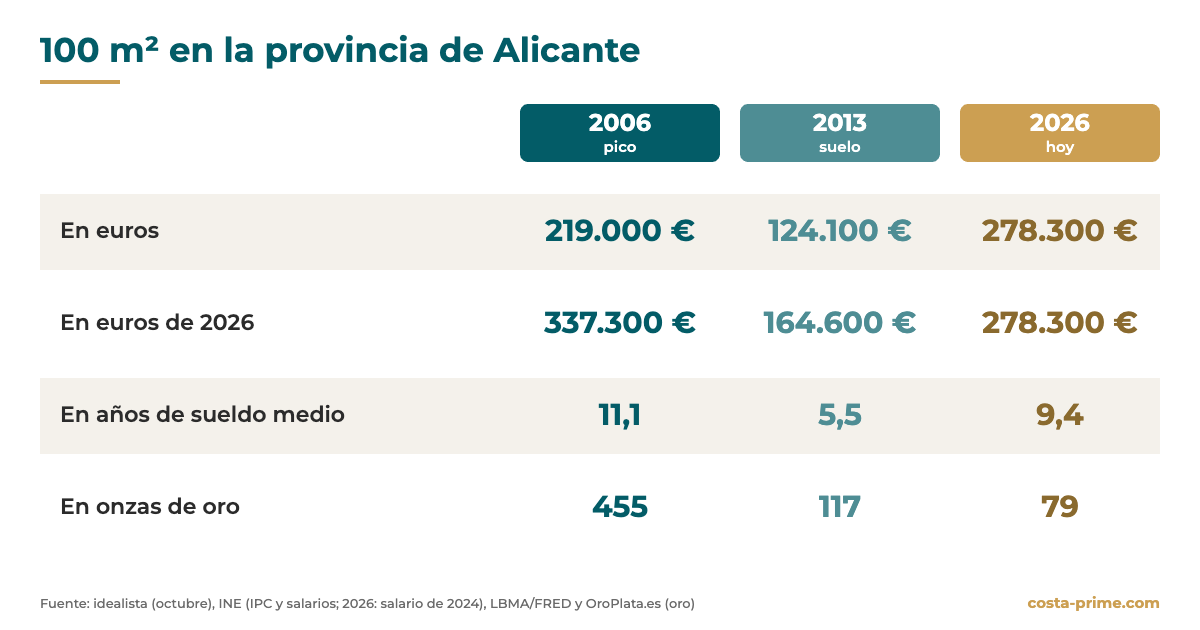
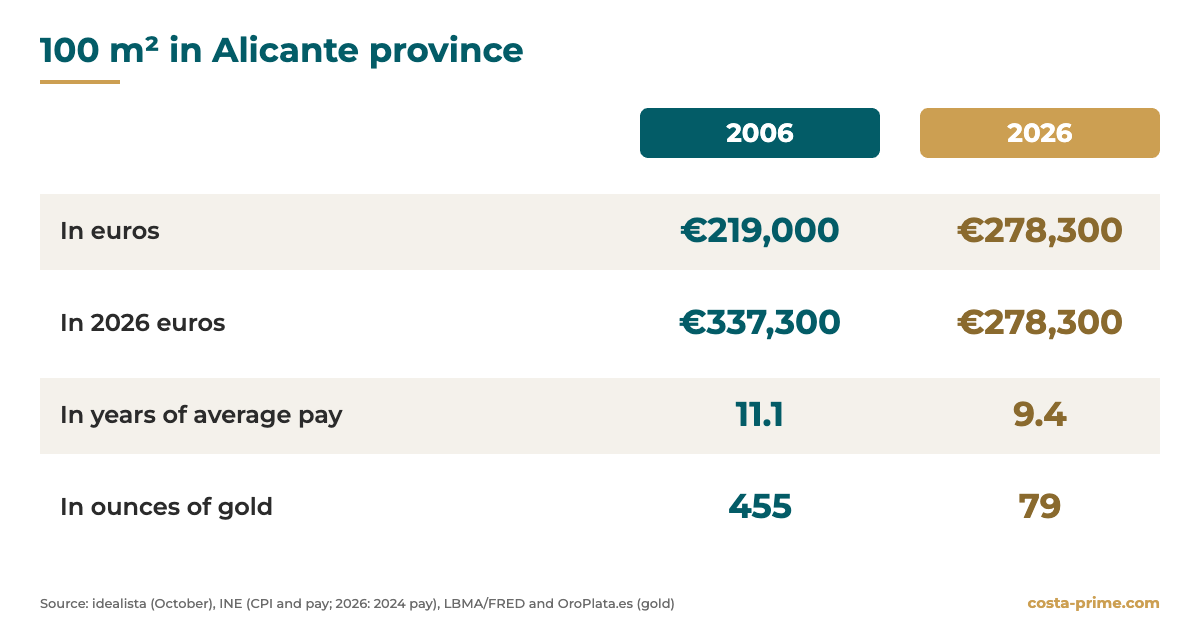
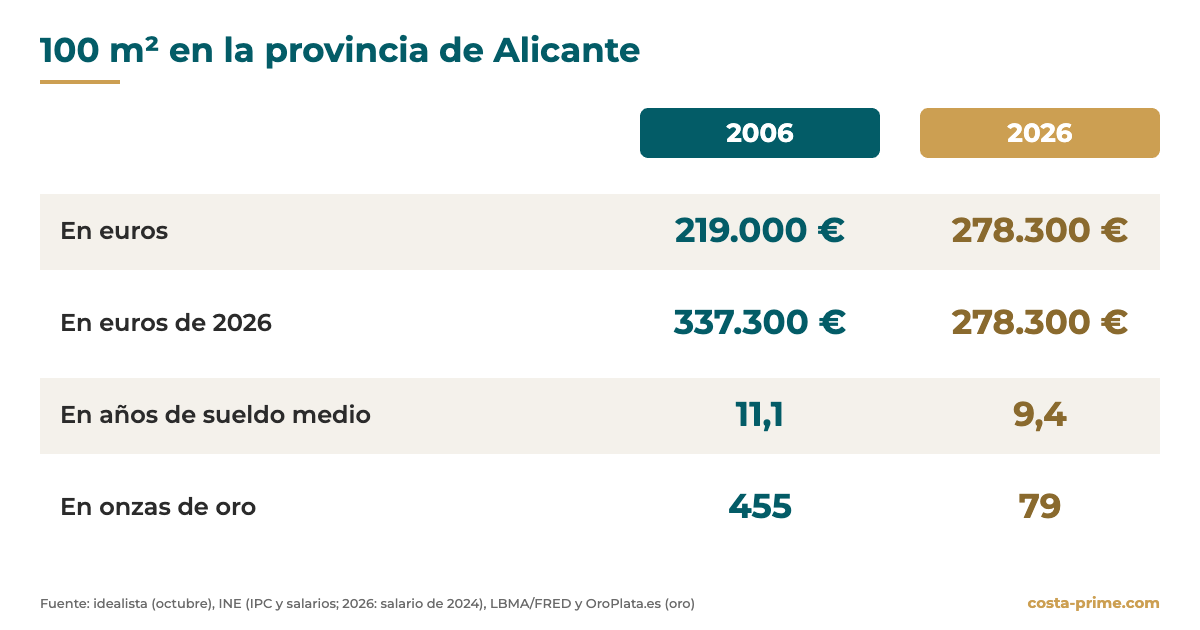
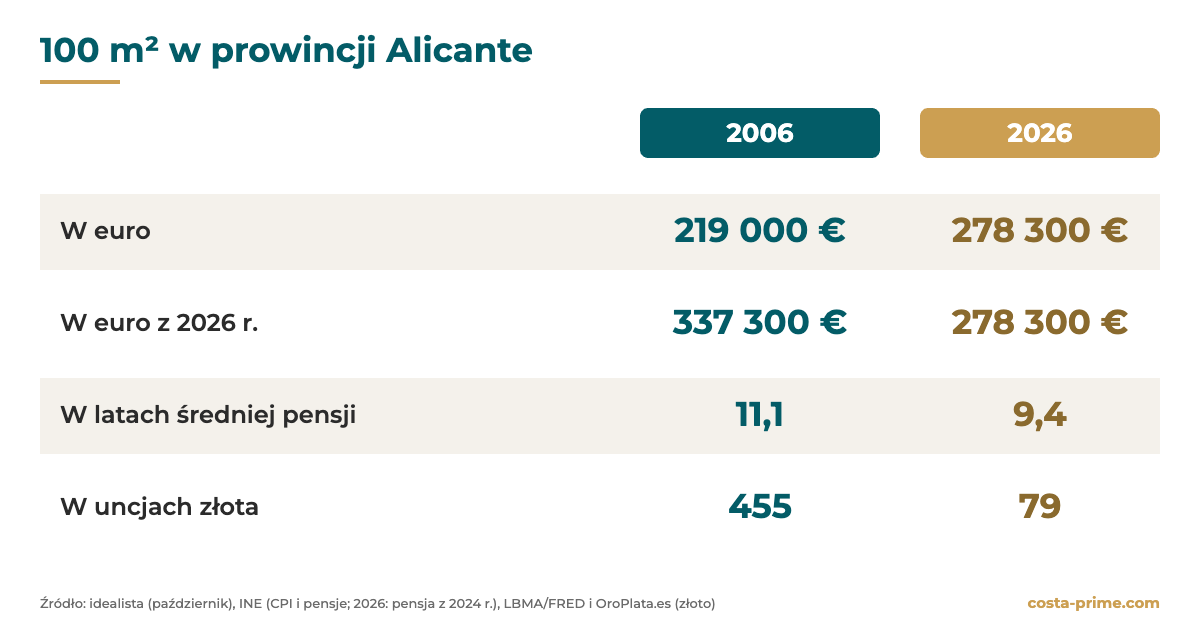
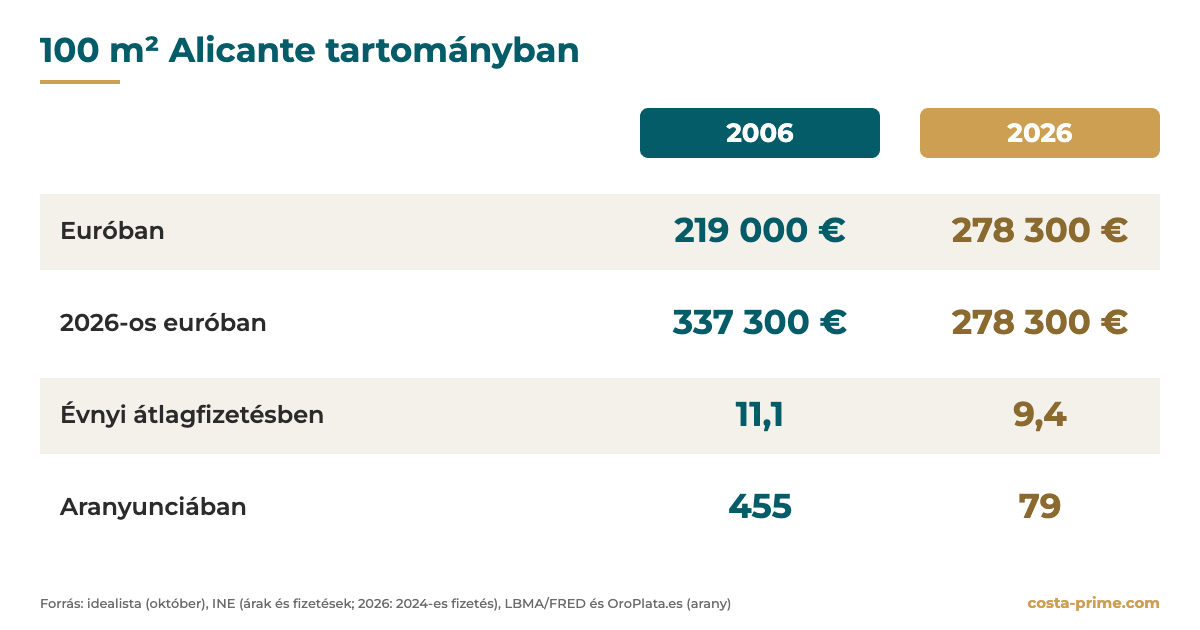
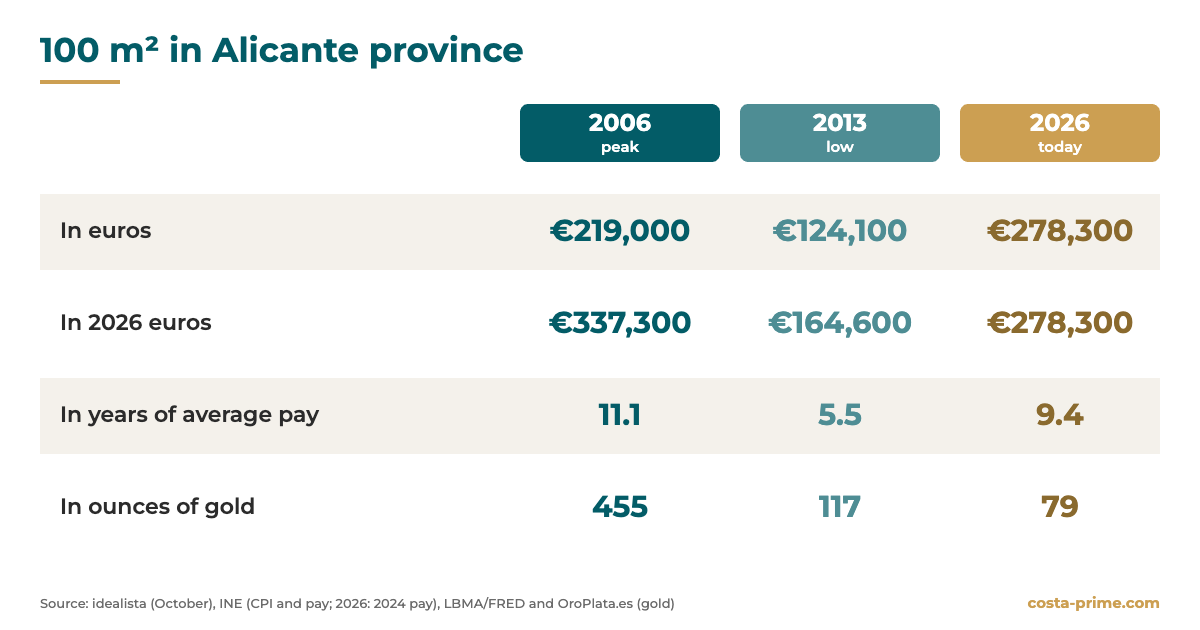
In today's euros, the 2,190 €/m² of 2006 is worth about 3,373 €/m². Today's 2,783 €/m² is therefore 17.5% lower in real terms. Homes cost more euros than ever, but each euro is worth a good deal less than in 2006.
Start from the 2013 low and the picture flips: the 1,241 €/m² of 2013 is about 1,646 €/m² in today's euros, so today's price is 69% higher in real terms.
In years of salary
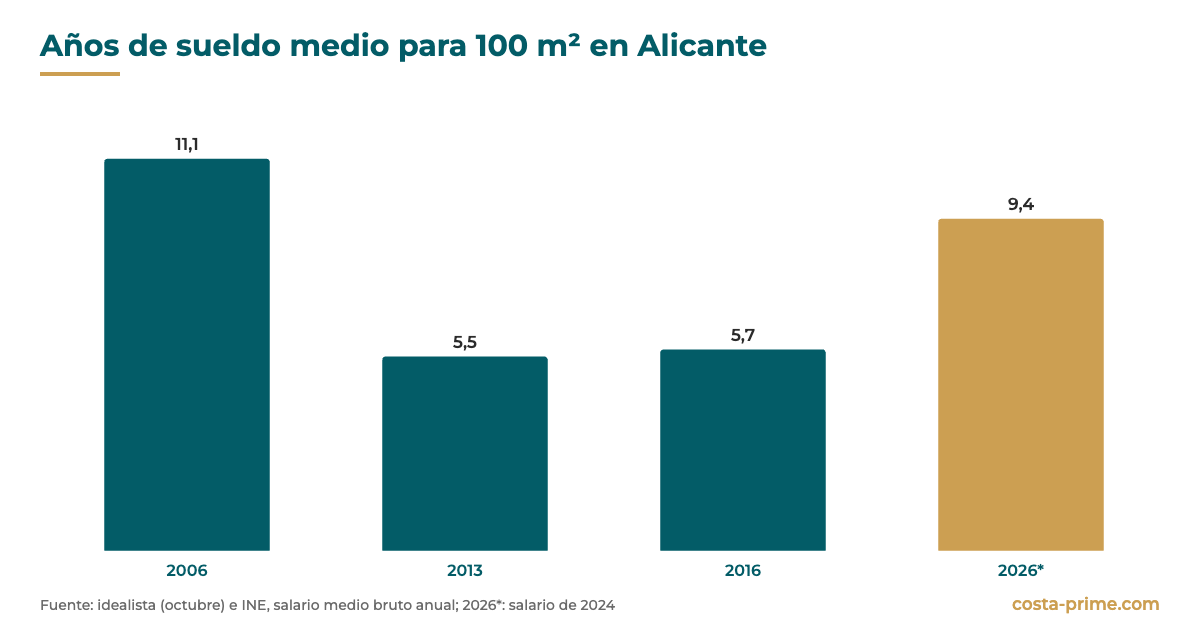
A measure closer to everyday life: how many years of average gross pay in Spain (INE, Wage Structure Survey) a 100 m² home costs at the provincial average price.
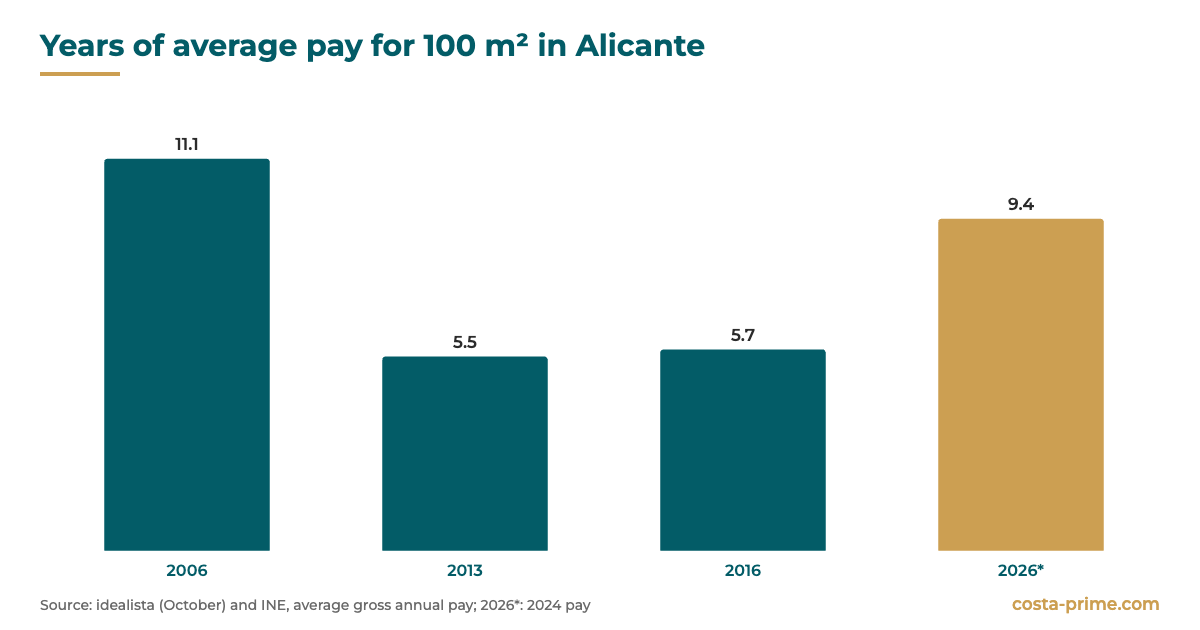
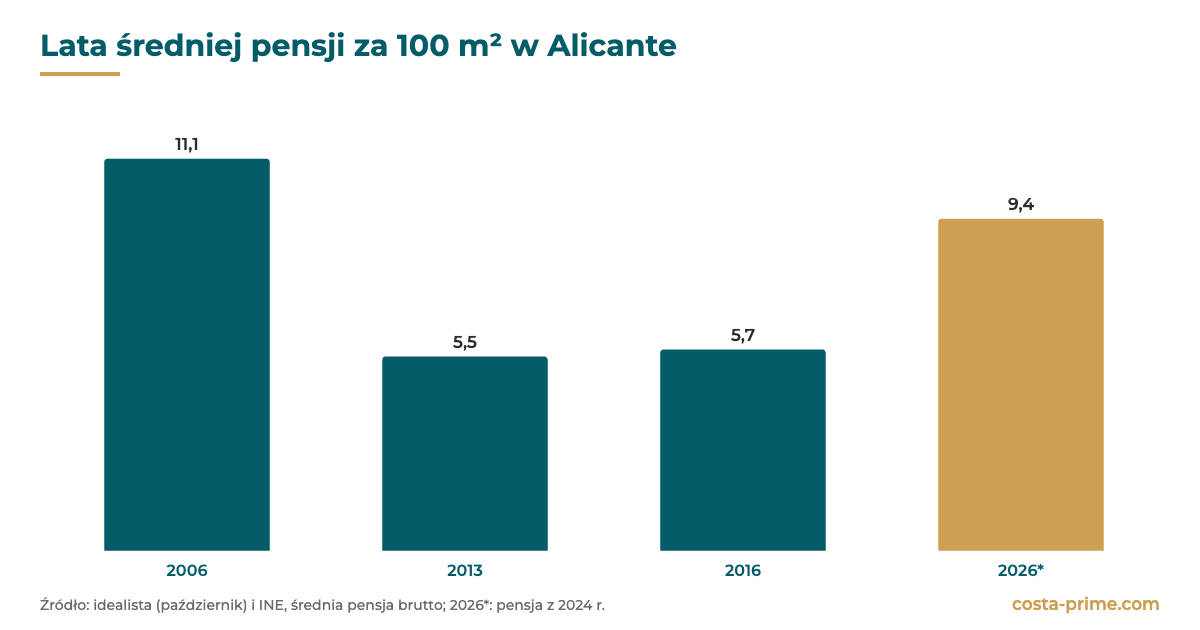
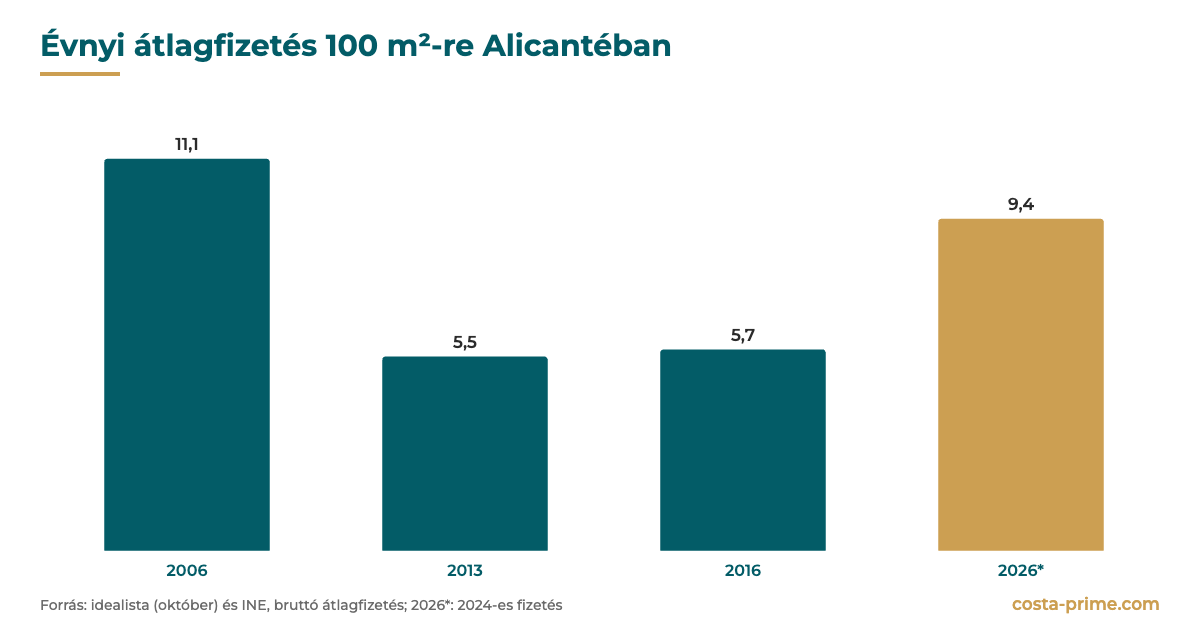
In 2006 it took 11.1 years of pay; in 2013, 5.5; in 2016, 5.7; and today 9.4, using 2024 pay (€29,540), the latest published. Homes have become much more expensive since 2016, but the effort is still below 2006. This is a national average: the real effort differs by area and by household.
In gold
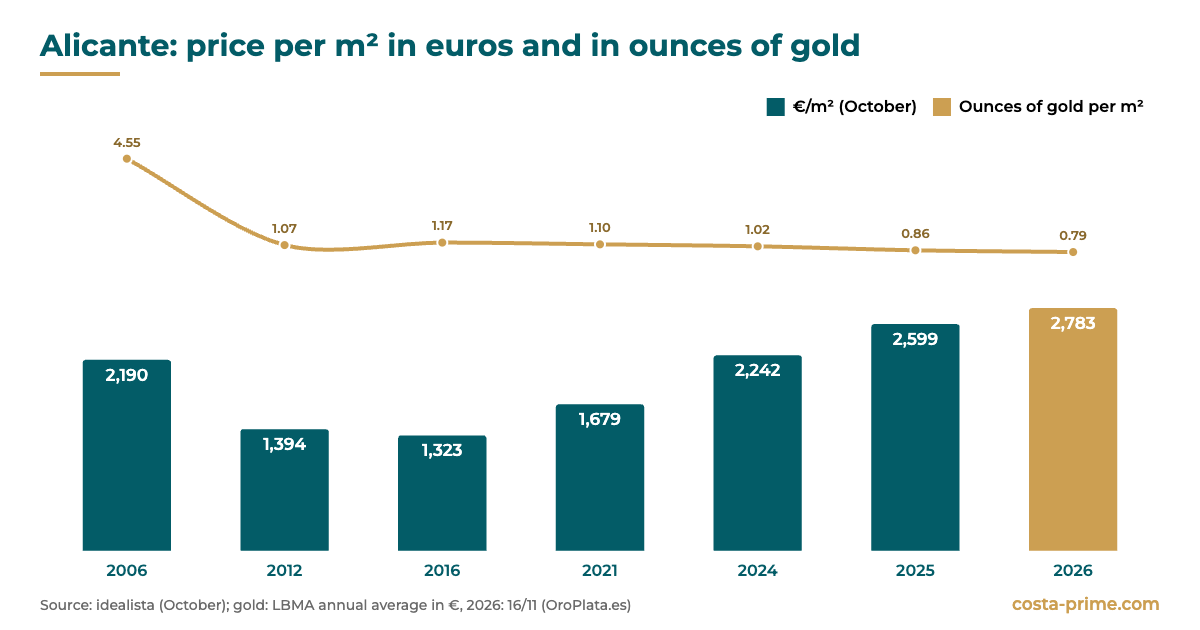
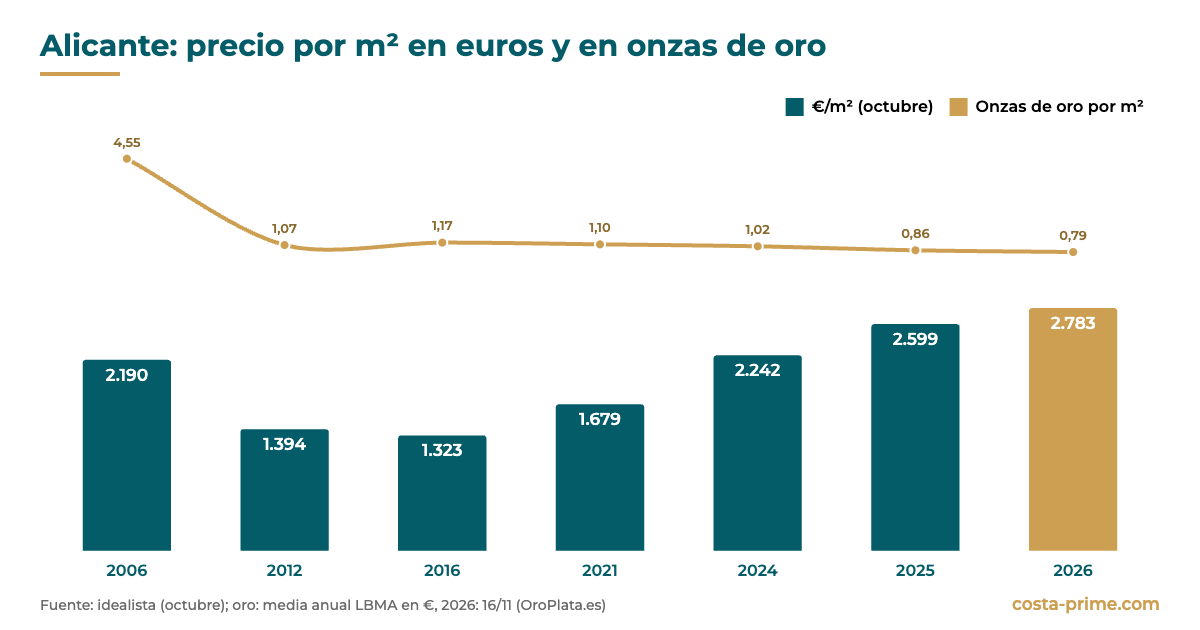
Gold is the classic yardstick because it does not depend on any central bank. We divide the price of a square metre by the price of an ounce of gold: idealista's October price and the average gold price of each year, converted to euros at the official exchange rate (for 2026, the price on 16 November).
| Year | Home price (€/m²) | Gold (€/oz) | Ounces per m² |
|---|---|---|---|
| 2006 | 2,190 | 481 | 4.55 |
| 2012 | 1,394 | 1,297 | 1.07 |
| 2016 | 1,323 | 1,130 | 1.17 |
| 2021 | 1,679 | 1,520 | 1.10 |
| 2024 | 2,242 | 2,206 | 1.02 |
| 2025 | 2,599 | 3,037 | 0.86 |
| 2026 | 2,783 | 3,514 | 0.79 |
In 2006, 100 m² cost around 455 ounces of gold; in 2016, about 117; today, about 79.
In shares and in bitcoin
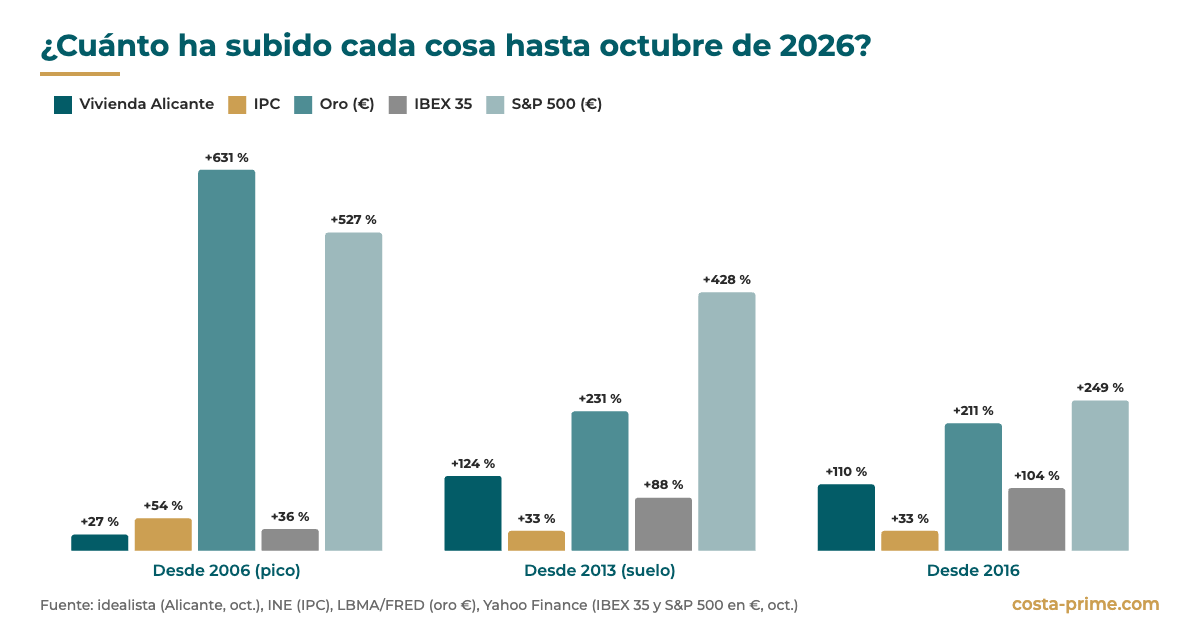
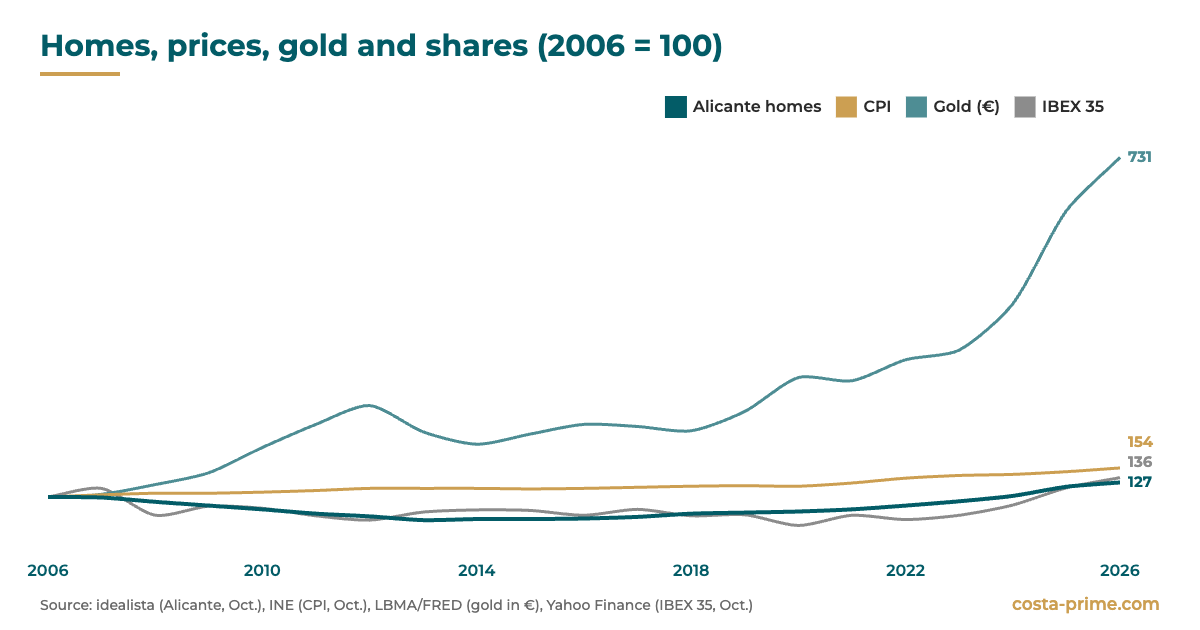
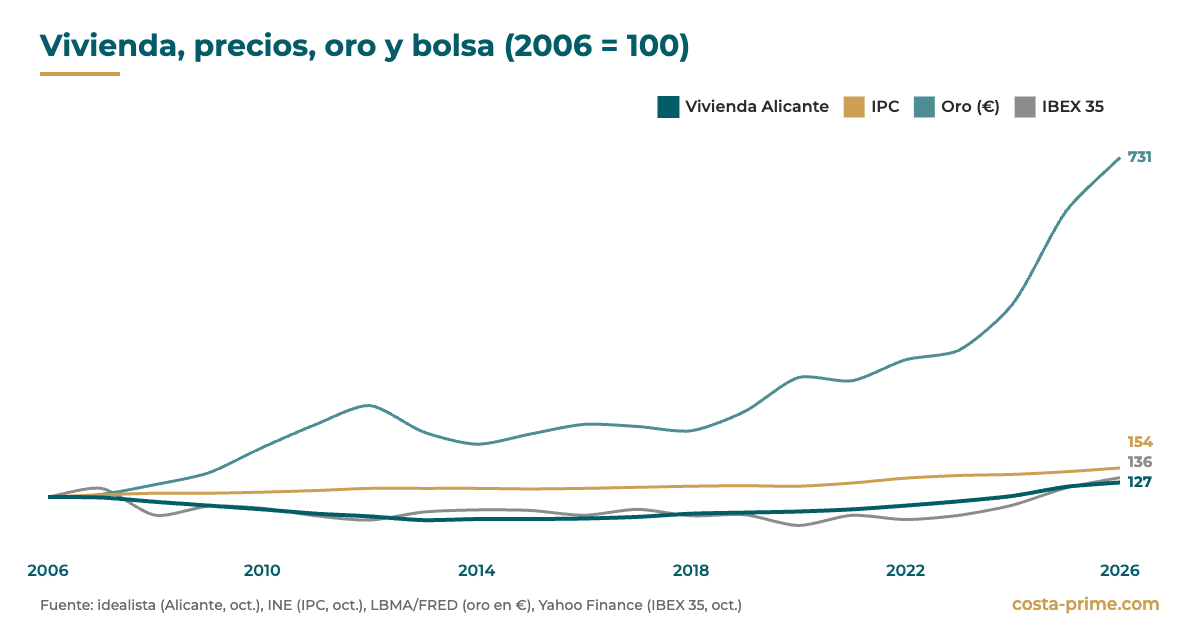
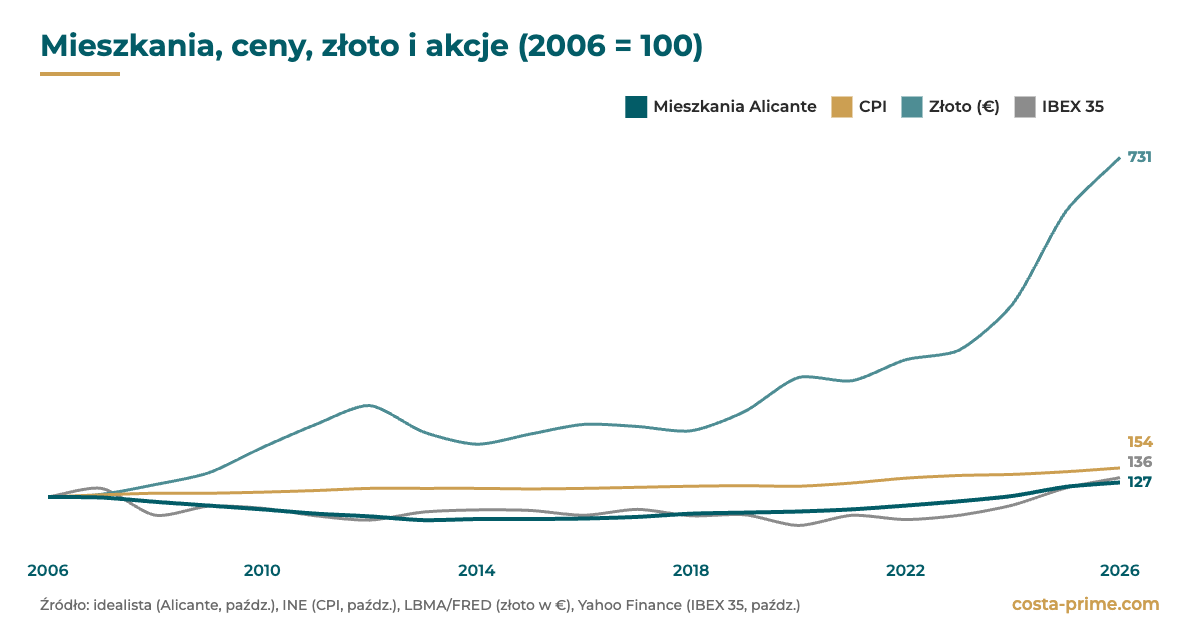
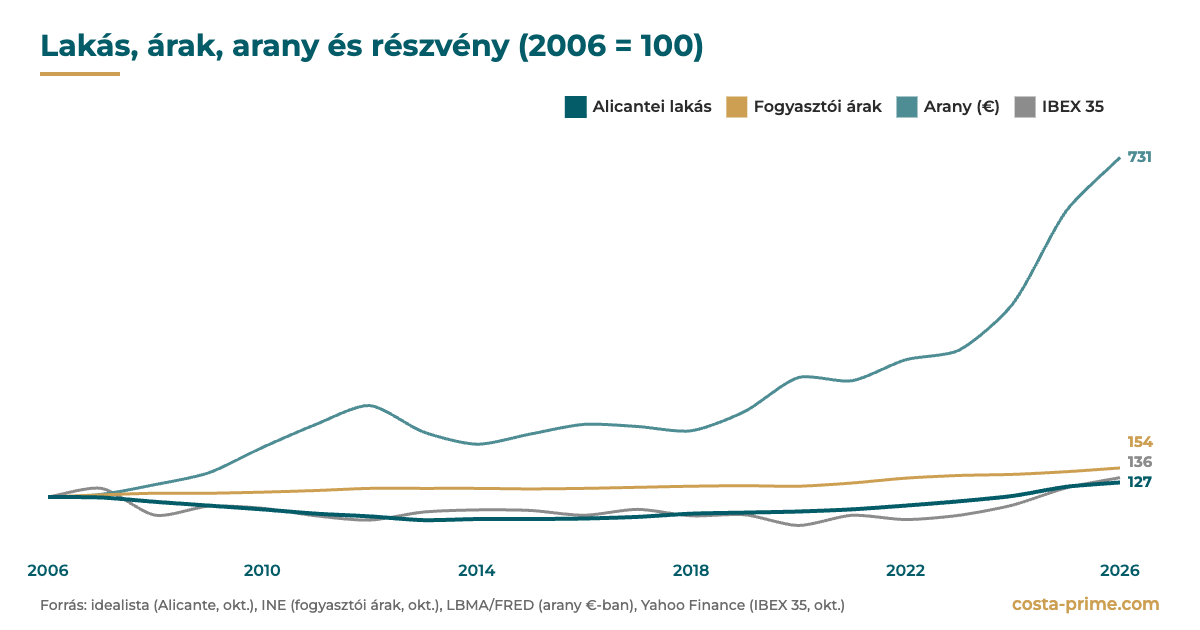
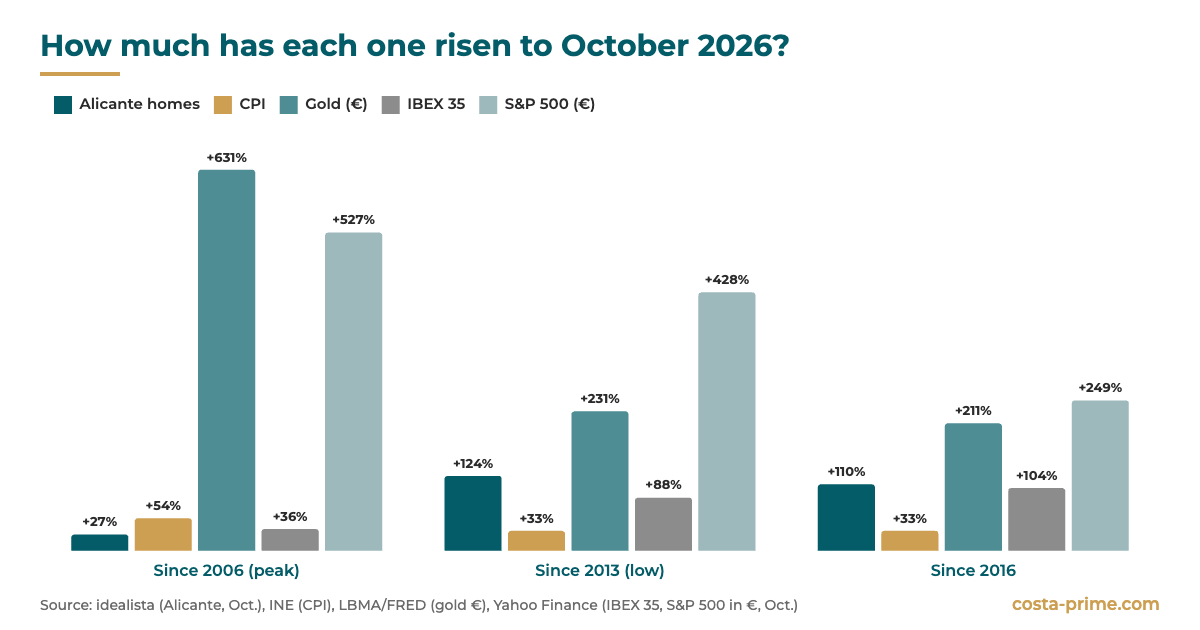
The IBEX 35 closed October 2026 at 18,653 points: 36% higher than in October 2006 and 104% higher than in October 2016. Over the same periods, homes rose 27% and 110% in euros. The IBEX is a price index: it leaves out dividends, which add to stock market returns, just as we leave out rents and running costs for the home.
The S&P 500, the main US stock index, has risen far more. Measured in euros, as a European saver would see it, it is up 527% since October 2006, 428% since 2013 and 249% since 2016 (in dollars, 450%, 332% and 257%). It also leaves out dividends.
Bitcoin shows how much the result depends on the yardstick: 100 m² cost about 207 bitcoins in October 2016 and about 4 in October 2026. But over the last year bitcoin fell 27% (from €94,453 to €69,141 at the end of October): such a volatile measure is useful to illustrate, not to compare.
How much has each one risen? It depends on the starting year
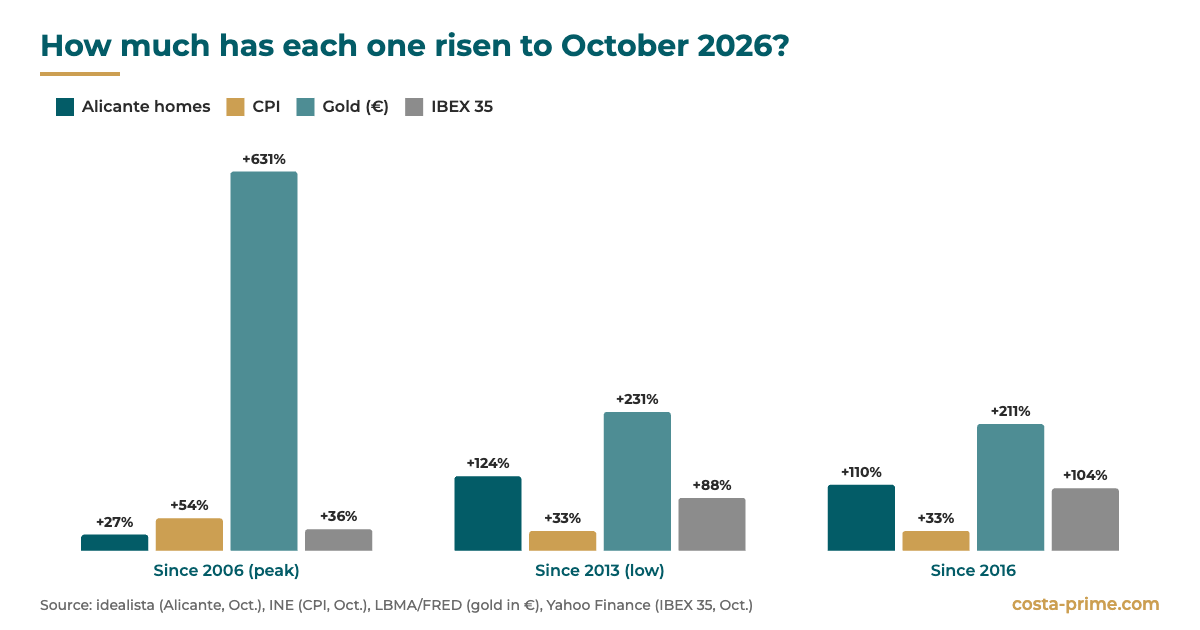
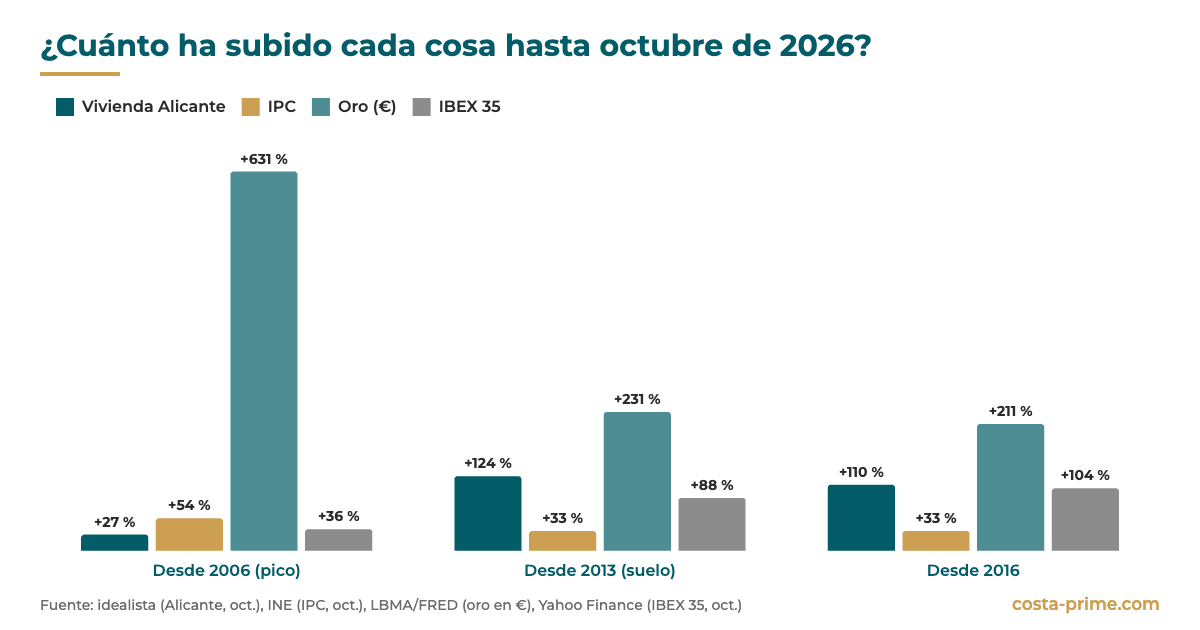
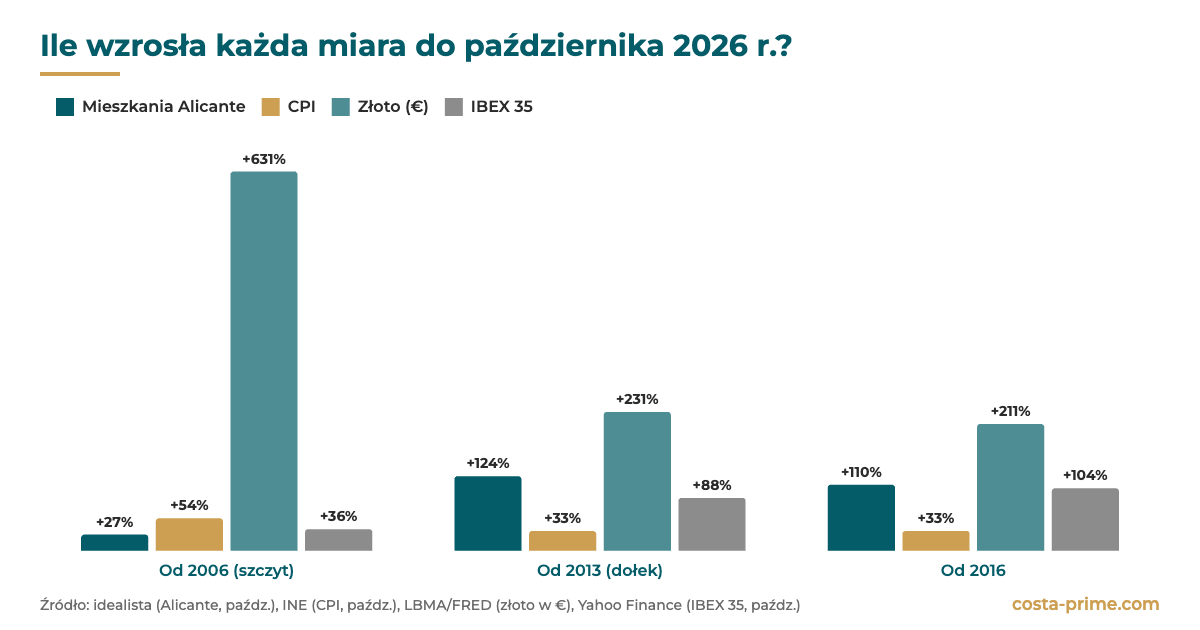
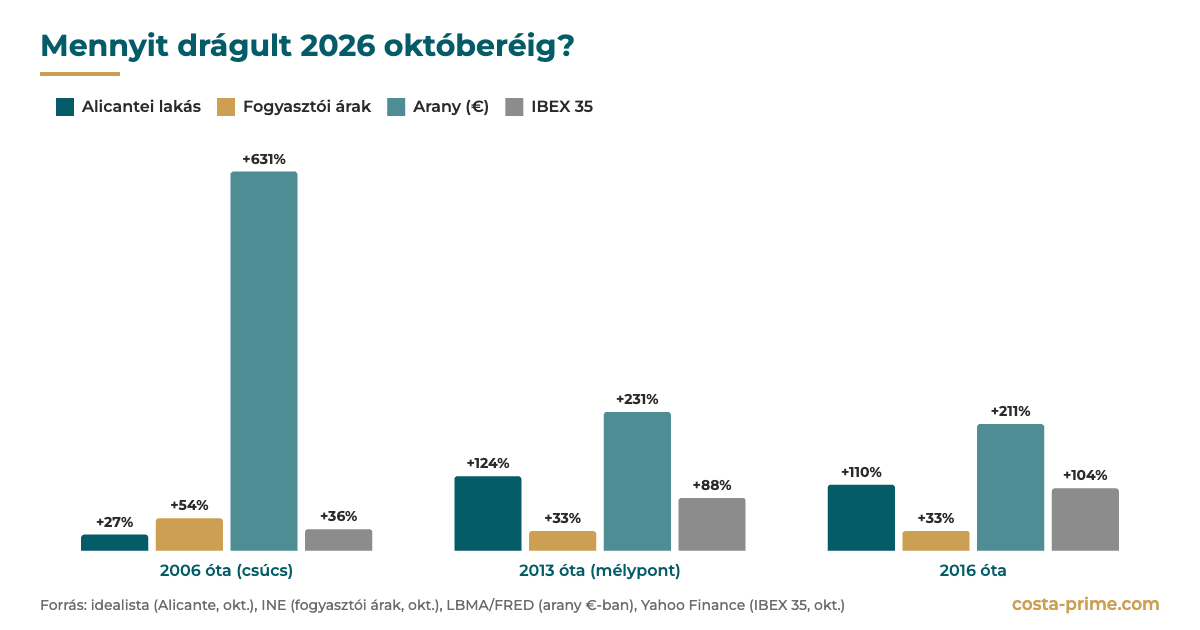
The chart compares the rise of each measure from three starting points: the 2006 peak, the 2013 low and 2016. From 2006, homes (+27%) rose less than consumer prices (+54%) and the IBEX (+36%). From 2013 or 2016 they more than doubled, well above inflation (+33%) and the IBEX (+88% and +104%), but less than gold (+231% and +211%) and the S&P 500 in euros (+428% and +249%). Gold rose most since 2006; the S&P 500 since 2013 and 2016. The starting year changes the conclusion as much as the yardstick.
In the foreign buyer's currency
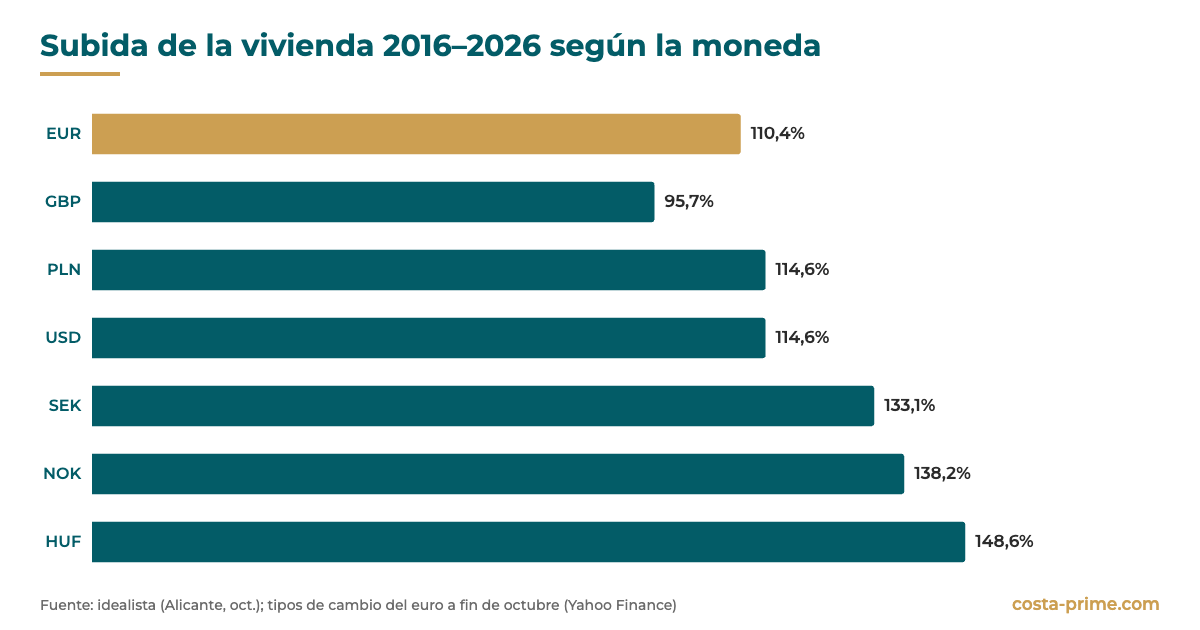
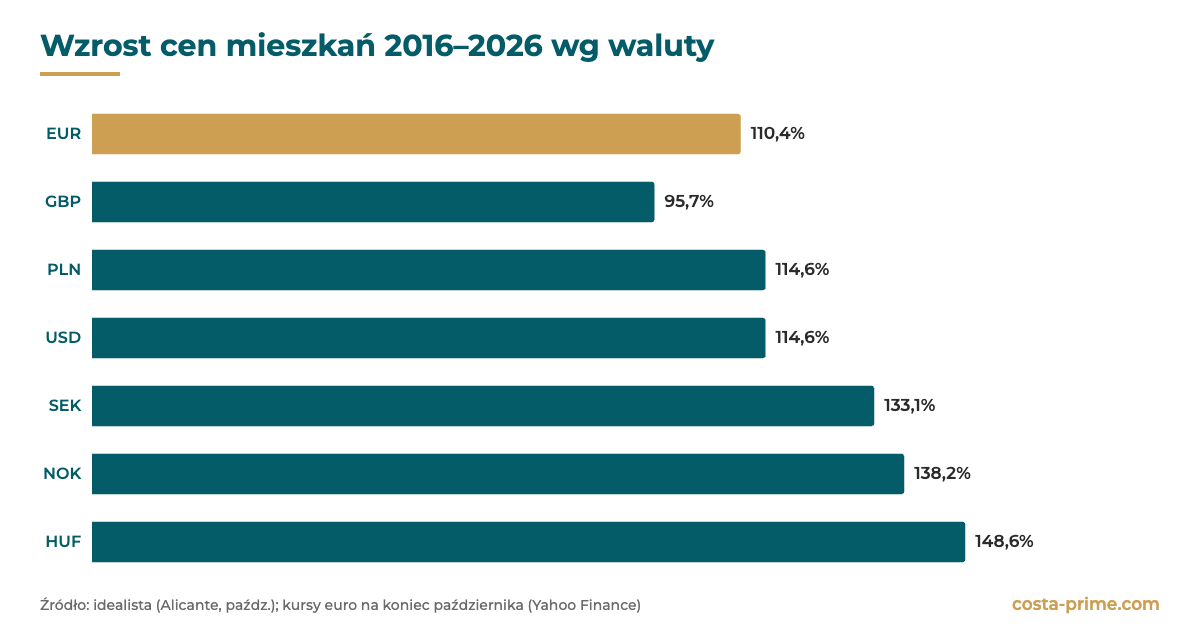
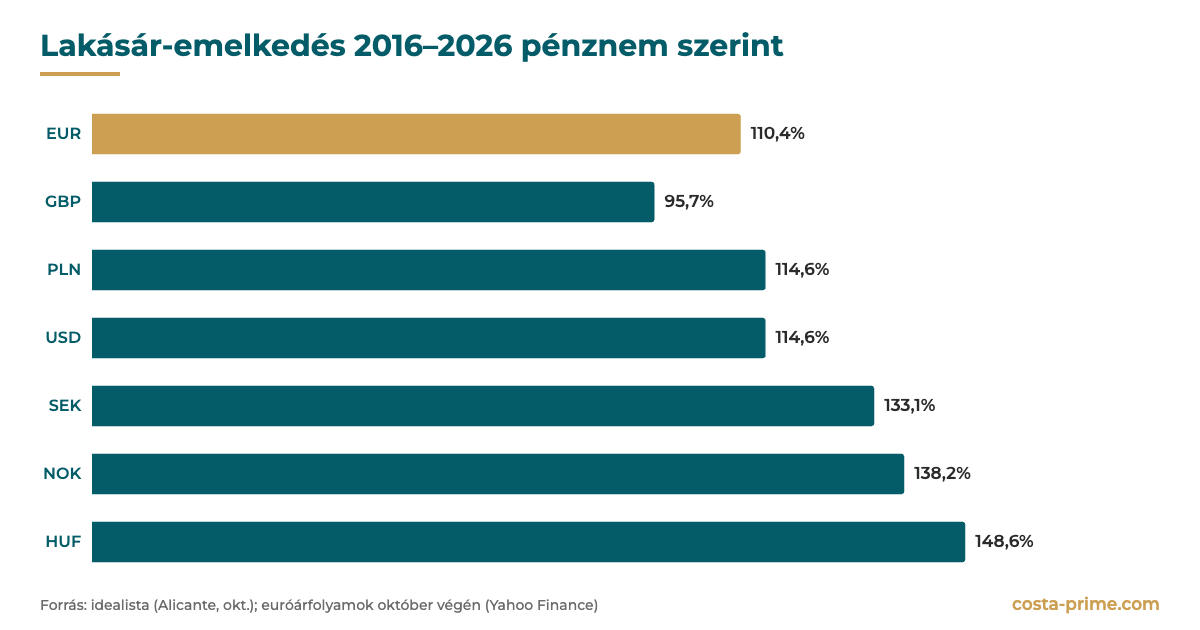
Many Costa Blanca buyers earn and save in another currency, so for them the price also depends on the exchange rate. Between October 2016 and October 2026, homes in Alicante rose 110% in euros, but 96% for someone paying in pounds, 115% in zlotys or dollars, 133% in Swedish kronor, 138% in Norwegian kroner and 149% in forints.
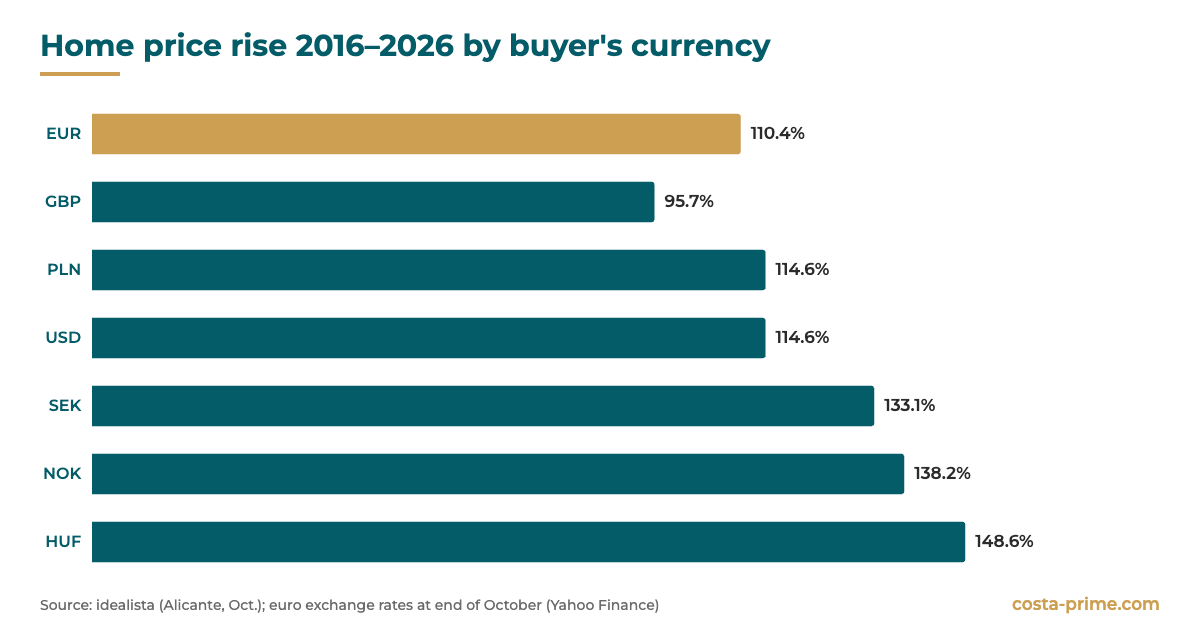
The exchange rate on the day you buy can matter as much as negotiating the price.
What this does and does not mean
- It does not mean homes are cheap. Most people earn, save and borrow in euros, and in euros homes are at a record high.
- It shows how much the euro has lost: part of the rise is inflation.
- Every measure has its limits: gold and bitcoin are volatile, stock indices leave out dividends, pay figures are national averages and prices are asking prices. The result depends a lot on the starting year.
- It is simply another way of looking at prices, not investment advice.
What this means for you
If you are selling: in euros your home is likely worth more than ever. If you plan to buy another one, compare both prices in the same currency and on the same date. A free valuation tells you what your home is worth today.
If you are buying: savings left in euros lose purchasing power every year. If your savings are in another currency or another asset, the exchange rate on the day you buy changes the real price you pay. Remember to add the costs of buying in Alicante.
Frequently asked questions
Are homes in Alicante more expensive than in 2006?
In euros, yes: 2,783 €/m² against 2,190 €/m² (idealista, asking prices). Adjusted for inflation they cost 17.5% less, and measured in gold around 80% less. From the 2013 low, however, they have risen 69% above inflation.
What is fiat money?
Money whose value is not backed by gold or another asset, but by trust in the issuer, such as the euro. Its purchasing power falls when prices rise.
Which measure is the right one?
None on its own. The euro is the currency you pay in; the others help you see whether a rise is real or just inflation, and how the price changes for someone saving in another currency or asset.
Want to know what your home is worth today? Ask Costa Prime for a free valuation. Office 965 064 440 · WhatsApp 601 868 660. You can also see our homes for sale in Alfaz del Pi and Albir. We specialise in Alfaz del Pi, Albir, La Nucía, Altea, Benidorm and Finestrat, with an office in Albir.
Sources
- idealista — Alicante price history (October of each year, asking prices), consulted 16/11/2026
- idealista — Alicante price report, October 2026: 2,783 €/m²
- INE — CPI general index (series IPC251852, base 2021), October of each year
- INE — CPI October 2026 (30/10/2026): 4.9% year on year
- INE — Wage Structure Survey 2006: €19,680.88 per worker
- INE — Wage Structure Survey 2016: €23,156.34 (2013: €22,697.86)
- INE — Annual Wage Structure Survey 2024: €29,540.26
- LBMA annual average gold price in USD (via MetalCharts)
- US Federal Reserve (FRED) — USD/EUR exchange rate, annual average
- OroPlata.es — gold price, 16/11/2026 13:35: 3,513.86 €/oz
- Yahoo Finance — IBEX 35 monthly closes (BME)
- Yahoo Finance — S&P 500 monthly closes, converted to euros at the end-October EUR/USD rate
- Yahoo Finance — BTC/EUR monthly closes
- Yahoo Finance — euro exchange rates, October 2016 and October 2026 month-end
Image gallery