


House Prices vs Salaries in Spain: the Affordability Gap
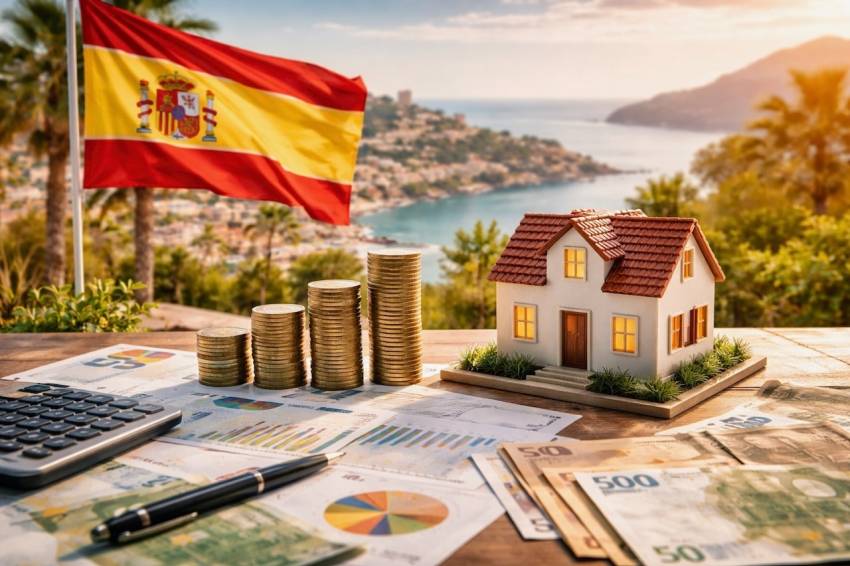
Housing prices in Spain keep rising: according to Gesvalt, the average price reached €2,085/m² in the third quarter of 2026, 10.6% more than a year earlier, and the Valencian Community rose 12.9%, above the national average. Demand, including foreign buyers, still exceeds the supply of homes for sale, especially on the coast.
Key points Updated: November 2026.
- Spain Q3 2026: €2,085/m², +10.6% year on year (Gesvalt).
- Valencian Community: +12.9%, one of the strongest increases.
- Main cause: more demand than supply of homes for sale, with little new build.
🏠 How Much Should We Be Earning Today If Salaries Had Kept Up With Housing Prices?
For years, we’ve heard that “housing is expensive.” But while that may be true, it doesn’t really explain the core issue.
To truly understand what has happened in Spain, there’s a much clearer way to look at it: not by focusing on property prices alone, but by asking a simple question:
👉 How many years of work does it take to buy a home?
And this is where the reality becomes much more striking.
📊 Spain in 1980 vs Today
If we go back to the late 1970s and early 1980s, the numbers were very different. At that time, the average annual salary in Spain was around 300,000 to 400,000 pesetas (approximately €1,800–€2,400 per year).
Meanwhile, the average property price ranged between 1.2 and 1.6 million pesetas (around €7,000–€10,000).
This means a home cost roughly 3 to 4 times the annual salary.
Today, the picture is very different. The average salary in Spain is around €31,000 per year, while the average property price is approximately €220,000–€260,000.
In other words, buying a home now requires 7 to 8 years of gross salary.
That’s roughly double what it was 40 years ago.
💸 The Often Overlooked Factor: Mortgages
Some people argue that it was harder in the past because interest rates were much higher. And that’s true—mortgage rates in the 1980s could reach 10% to 15%.
However, mortgages were shorter (typically 10–15 years), and more importantly, property prices were much lower.
Even with high interest rates, the overall financial effort remained manageable.
When everything is taken into account, a buyer in 1980 would spend approximately 8 to 10 years of salary to fully pay off their home.
Today, the situation is reversed. While interest rates have been relatively low in recent years (around 2%–4%), mortgage terms have extended to 25 or even 30 years, and property prices are significantly higher.
As a result, the total effort rises to approximately 12 to 14 years of salary.
🧮 A Simple Example
Let’s compare two real-life scenarios.
In 1980, someone earning around €2,000 per year could buy a home for about €8,000. After paying the mortgage, the total cost would be roughly €16,000—equivalent to about 8 years of salary.
Today, someone earning €31,000 per year faces property prices of around €240,000. The total mortgage cost can reach close to €400,000.
That means a total effort of around 13 years of salary.
👉 Today, you need to work several more years to achieve the same goal.
🚨 So… How Much Should We Be Earning Today?
This is where things get particularly interesting.
If salaries in Spain had increased at the same pace as housing prices since the late 1970s, the average salary today wouldn’t be around €31,000.
It would be significantly higher.
To maintain the same level of affordability as in 1980, the average salary would need to be approximately:
💥 €120,000 to €150,000 per year
👉 That’s roughly €10,000 to €12,500 per month
🔍 Why Has This Happened?
This gap is the result of several long-term factors.
Easier access to credit from the 1990s onwards allowed more people to buy homes, which pushed prices higher. At the same time, investment demand—both domestic and international—has grown significantly.
In many areas, especially coastal regions, tourism and foreign buyers have added further pressure on prices, while housing supply has not kept up.
Meanwhile, salaries have grown much more slowly.
📉 Market Consequences
This imbalance explains many current trends.
Fewer local buyers can afford to purchase property, while the market increasingly relies on foreign buyers and higher-income profiles.
At the same time, more people are forced into renting, which drives rental prices higher.
There is also a widespread feeling that “everything is expensive.” But in reality:
👉 The real issue is that salaries have not kept pace with housing.
📌 Conclusion
Buying a home in Spain today is not just more expensive in absolute terms—it requires significantly more effort relative to income.
In real terms, the effort has increased by around 30% to 50% compared to 40 years ago.
And that has fundamentally changed access to housing and the structure of the real estate market.
Frequently asked questions
Why do prices keep rising? There are more buyers than homes for sale: household formation, foreign demand and little new construction. Mortgage rates have also eased compared with 2023.
Is it a good time to sell? With prices rising and demand active, well-priced homes sell faster. The key is an asking price based on real comparable sales in your area.
And to buy? Waiting does not guarantee lower prices while supply is short. Check how much the bank will lend you first so you can move quickly when the right home appears.
See how much a bank would lend you after the October Euríbor.
Thinking of selling? Find out what your home is worth with our free valuation, call us on +34 965 064 440 or message us on WhatsApp on +34 601 868 660. We specialise in Alfaz del Pi, Albir, La Nucía, Altea, Benidorm and Finestrat, with our office in Albir (Alfaz del Pi).
Sources: Gesvalt via Rankia (02/11/2026).